Skip to content
  • About
  • Books & Publications
    • Books
    • Journal Articles
    • Chapters
    • Research and Policy reports
    • AE4RIA & 360info Science-Policy Briefs 
    • Working Papers
  • Projects
    • Climate Neutrality & Resilience
    • Sustainable Oceans & Seas
    • Sustainable WFEB Nexus
    • Innovation Acceleration
    • Socio-Economics & Financial Pathways Behavioral Economics
    • Education & Skills
    • Global, European, Euro-Asian Initiatives
      • The Lancet Commission
      • SDSN European Green Deal Senior Working Group
      • Global Roundtable for Sustainable Shipping and Ports
      • UN SDSN Sustainable Euro-Asian Seas Initiative
  • Speeches and Presentations
  • Multimedia
    • Gallery
    • Videos
    • Project Videos
    • Public Press
    • Newsletters
    • Activity Reports
  • Courses
  • Scientific Conferences
  • News
  • Contact
Menu
  • About
  • Books & Publications
    • Books
    • Journal Articles
    • Chapters
    • Research and Policy reports
    • AE4RIA & 360info Science-Policy Briefs 
    • Working Papers
  • Projects
    • Climate Neutrality & Resilience
    • Sustainable Oceans & Seas
    • Sustainable WFEB Nexus
    • Innovation Acceleration
    • Socio-Economics & Financial Pathways Behavioral Economics
    • Education & Skills
    • Global, European, Euro-Asian Initiatives
      • The Lancet Commission
      • SDSN European Green Deal Senior Working Group
      • Global Roundtable for Sustainable Shipping and Ports
      • UN SDSN Sustainable Euro-Asian Seas Initiative
  • Speeches and Presentations
  • Multimedia
    • Gallery
    • Videos
    • Project Videos
    • Public Press
    • Newsletters
    • Activity Reports
  • Courses
  • Scientific Conferences
  • News
  • Contact

Follow

Facebook Twitter Instagram Dstream-google2
Search
Close

Home > Parallel Session V Overview – Policy Solutions, Spatial Dynamics and Socio-Economic Development

Parallel Session V Overview – Policy Solutions, Spatial Dynamics and Socio-Economic Development

Midday sessions turned to policy-level applications of BCA, spanning intergenerational discounting, electric vehicle diffusion, and the capitalization of energy efficiency in housing markets. Further papers addressed urban recovery in Ukraine, innovative predictive approaches, multilateral development bank practice in water and sanitation, and the role of BCA in higher education and institutional development.

Parallel Session on Climate, Environment & Energy: Policy Solutions and Spatial Diffusion, chaired by Marco Percoco (Università Bocconi), explored how policy design and spatial patterns shape environmental outcomes. Monika Foltyn-Zarychta and Rafał Buła (University of Economics in Katowice) investigated individual discount rates for intergenerational trade-offs, while Marco Percoco analysed fiscally regressive subsidies and the spatial diffusion of electric vehicles in French cities, and Kryštof Veřtát (Charles University) examined how energy efficiency is capitalised into housing values using spatial econometric modelling.

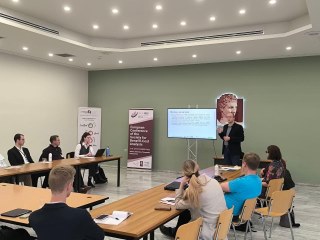


Under the theme Climate, Environment & Energy: Energy Efficiency, Daniel Herrera (Mines Paris – PSL) chaired Parallel Session 22, which addressed Europe’s energy transition through ICT, housing markets and energy-market design. Konstantinos Varsos (Athens University of Economics and Business) presented the EXIGENCE approach to incentives for carbon-aware ICT services, Marcin Jałbrzykowski (University of Warsaw) discussed the European energy market from an institutional perspective, and Daniel Herrera analysed the effect of phasing out energy-inefficient dwellings on housing demand using a sorting model framework.


Parallel Session 21, Advances in BCA Methods: BCA and Socio-Economic Development, chaired by Daria Kuznetsova (KTH Royal Institute of Technology), highlighted how BCA informs reconstruction and development policy. Daria Kuznetsova and Sviatlana Engerstam (KTH) presented on the use of BCA for urban development in Ukraine’s recovery, Ioannis Stampoulidis (AUEB) introduced innovative methods to improve predictability in BCA, Omran A. H. Musa (London School of Hygiene and Tropical Medicine) reviewed the use and quality of BCA in water and sanitation projects across three multilateral development banks, and Lusani Mulaudzi (University of Cape Town) evaluated an academic development programme at a South African university, underscoring BCA’s role in guiding socio-economic progress.


Share on facebook
Share on twitter
Share on linkedin

The Alliance of Excellence for Research and Innovation on Aeiphoria (AE4RIA) is an unofficial umbrella for the collaboration of the following institutions:

  • Research and Innovation Centres:
  • ReSEES LABORATORY -AUEB
  • S.D.U-ATHENA
  • DTU Management Department of Technology, Management and Economics Climate and Energy Policy Division
  • Stochastic Modeling and Applications Laboratory - AUEB
  • Innovation Acceleration Hubs:
  • SDSN Global Climate Hub
  • MENA Maritime Accelerator
  • Black Sea Accelerator
  • BRIGAID Connect Association
  • EIT Climate- KIC
  • Science - Policy Networks
  • Sustainable Development Solutions Network
  • SDSN Global Climate Hub
  • Sustainable Development Solutions Network Europe
  • Sustainable Development Solutions Network Greece
  • NEXUS Cluster
  • WATER EUROPE
  • Scientific Associations and Academies
  • European Association of Environmental and Resource Economists (EAERE)
  • World Council of Environmental and Resource Economists Associations (WCEREA)
  • Academia Europaea
  • World Academy of Art and Science (WAAS)
  • InterAcademy Partnership (IAP)
  • European Academy of Sciences and Arts

Newsletter

© 2026 Phoebe Koundouri All Rights Reserved – Powered by Biznet Infoservices Ltd. Design & Development by Dstream